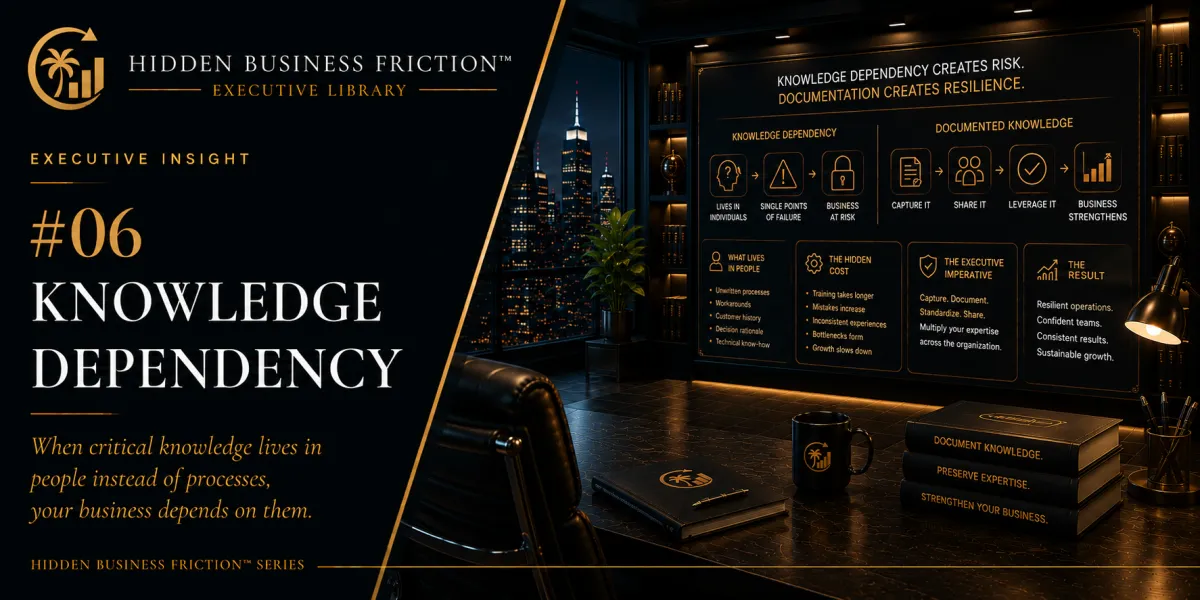
Hidden Business Friction™ #6
Knowledge Dependency
5 min read • Executive Insight
Introduction
Every organization has people everyone depends on.
The employee who knows how to solve every unusual customer issue.
The manager who remembers why a process exists.
The technician who can fix a problem no one else understands.
Their experience is valuable.
But when critical knowledge exists only inside people's heads, the business becomes far more fragile than it appears.
This is one of the most overlooked forms of Hidden Business Friction™.
The Hidden Friction
Tribal knowledge develops slowly.
Someone discovers a better way.
They share it verbally.
Another employee asks later.
No one documents it because it's quicker to simply answer the question.
Over time, the organization unknowingly creates single points of failure.
The business continues running smoothly—until someone is unavailable, retires, or resigns.
Then the gaps become visible.
Why It Matters
When knowledge isn't documented:
Training takes longer.
Mistakes increase.
Customers receive inconsistent experiences.
Managers spend more time answering questions.
Experienced employees become bottlenecks.
Growth becomes increasingly difficult to sustain.
The problem isn't that employees become experts.
The problem is allowing expertise to remain trapped inside individuals instead of becoming part of the organization.
Executive Perspective
High-performing organizations don't eliminate expertise.
They multiply it.
Processes shouldn't replace people.
They should preserve what your best people have learned so the entire organization benefits.
Documentation isn't bureaucracy.
It's organizational memory.
Questions for Leadership
If one key employee didn't return tomorrow, what work would immediately stop?
Which critical processes exist only in someone's memory?
Where do employees consistently say, "Go ask them"?
How long would it take to train someone to perform your most important operational tasks?
Is knowledge treated as an organizational asset or an individual advantage?
Key Takeaways
Tribal knowledge creates hidden operational risk.
Expertise should strengthen the organization—not become a dependency.
Documenting processes increases resilience and consistency.
Every undocumented workflow is potential Hidden Business Friction™.
Continue Exploring Hidden Business Friction™
Next Executive Insights
→ Hidden Business Friction™ #7 — Reactive Management
→ Hidden Business Friction™ #8 — Knowledge Silos
→ Hidden Business Friction™ #9 — The Cost of Poor Handoffs
Discover Your Organization's Hidden Friction
The Hidden Business Friction™ Executive Diagnostic helps leadership identify where operational knowledge is concentrated, where process documentation is missing, and where hidden dependencies are limiting scalability and resilience.
Complete the assessment to receive a personalized Executive Report highlighting knowledge gaps, operational risks, executive priorities, and practical recommendations for building systems that preserve expertise and support sustainable growth.