Hidden Business Friction™ #5
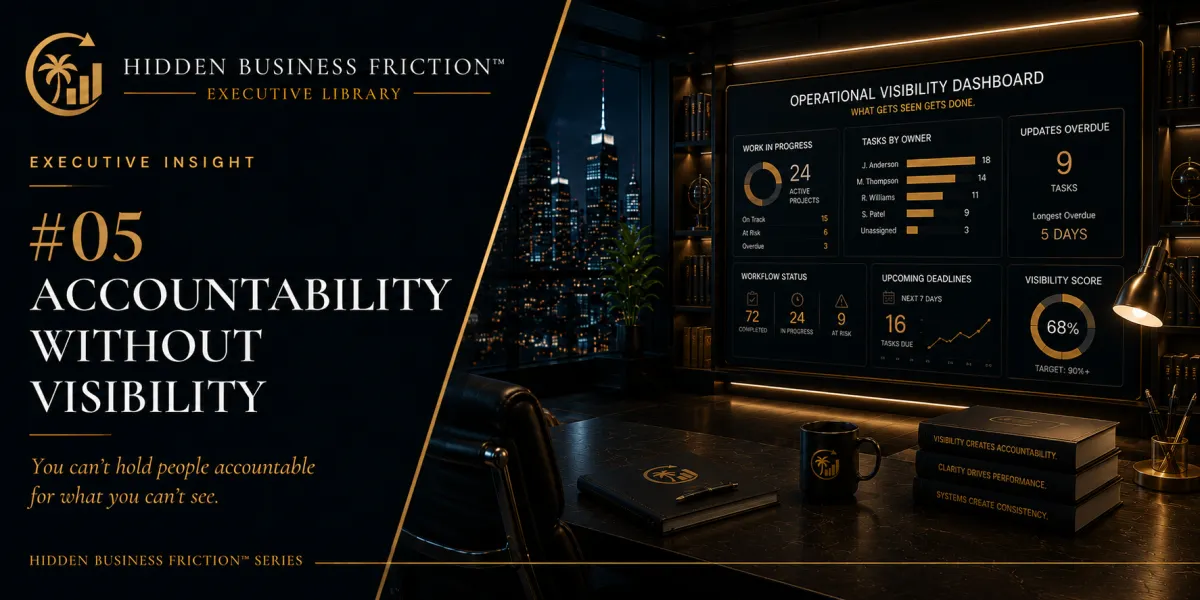
Accountability Without Visibility
4 min read • Executive Insight
Introduction
Most leaders believe accountability begins with people.
In reality, it begins with visibility.
You cannot hold employees accountable for work that leadership cannot clearly see.
When priorities, responsibilities, and progress remain hidden, accountability becomes reactive instead of proactive. Managers spend their time searching for answers instead of making decisions.
True accountability is only possible when work is consistently visible.
The Hidden Friction
Many organizations operate with the assumption that everyone knows what everyone else is doing.
Projects are discussed in meetings but never documented.
Customer updates live inside email threads.
Tasks are remembered instead of tracked.
Critical knowledge exists inside one employee's head.
When everything appears to be moving, these hidden gaps often go unnoticed.
The problems emerge when someone is absent, priorities change, or customers begin asking questions.
Suddenly leadership is trying to answer simple questions:
Who owns this?
Has this been completed?
Who was supposed to follow up?
What is causing the delay?
The issue is rarely a lack of effort.
It is a lack of visibility.
Without a clear view of work in progress, accountability becomes based on assumptions instead of facts.
Why It Matters
Organizations without operational visibility struggle to identify problems before they become costly.
Managers spend valuable time chasing updates instead of leading.
Employees duplicate work because they cannot see what has already been completed.
Important tasks stall because ownership is unclear.
Customers experience delays without anyone recognizing where the breakdown occurred.
As organizations grow, these invisible gaps multiply.
The result is slower execution, inconsistent customer experiences, frustrated employees, and leadership teams that feel increasingly disconnected from daily operations.
Without visibility, accountability becomes impossible to measure consistently.
Executive Perspective
High-performing organizations understand that accountability is not created through pressure.
It is created through clarity.
When work is visible, expectations become transparent.
Ownership becomes obvious.
Progress becomes measurable.
Problems are identified early instead of after customers begin complaining.
Visibility removes guesswork.
It allows leaders to coach instead of investigate, improve instead of react, and make decisions based on facts rather than assumptions.
Operational visibility is not about monitoring people.
It is about creating an environment where everyone understands what needs to happen, who owns it, and how progress is measured.
That is where real accountability begins.
Questions for Leadership
Can leadership quickly see the status of every important initiative?
Is ownership clearly assigned for every critical task?
Would work continue smoothly if a key employee were absent tomorrow?
Can delays be identified before customers notice them?
Are decisions based on real operational visibility or verbal updates?
Key Takeaways
• Accountability depends on visibility before it depends on performance.
• Hidden work creates hidden risk.
• Operational visibility reduces confusion, delays, and duplicated effort.
• Leaders can only improve what they can consistently see.
Continue Exploring Hidden Business Friction™
Next Executive Insights
→ Hidden Business Friction™ #6 — Process Drift
→ Hidden Business Friction™ #7 — The Cost of Workarounds
→ Hidden Business Friction™ #8 — Knowledge Silos
Discover Your Organization's Hidden Friction
Most accountability problems are actually visibility problems.
The Hidden Business Friction™ Executive Diagnostic helps leadership identify where operational visibility breaks down, where ownership becomes unclear, and where hidden friction is slowing execution.
Complete the assessment to receive a personalized Executive Report highlighting operational blind spots, executive priorities, and practical recommendations for improving accountability, visibility, and organizational performance.