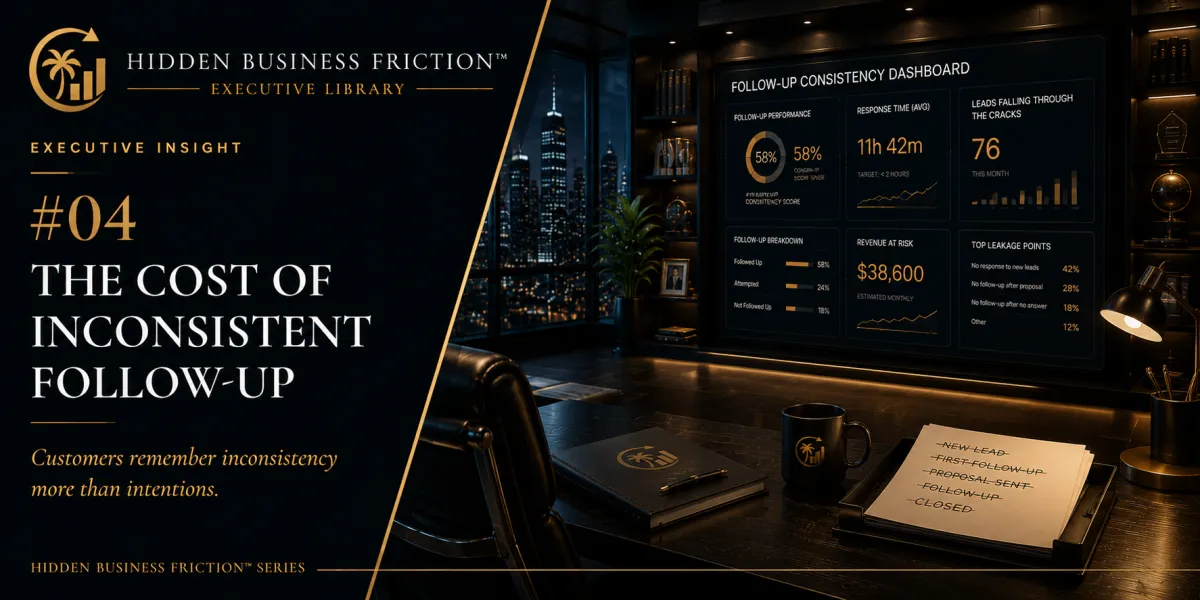
Hidden Business Friction™ #4
The Cost of Inconsistent Follow-up
6 min read • Executive Insight
Introduction
Most organizations don't lose customers because they stop caring.
They lose customers because caring becomes inconsistent.
The first interaction is responsive.
Questions are answered.
Proposals are delivered.
Expectations are set.
Then something changes.
Updates become less frequent.
Follow-up slows.
Communication becomes unpredictable.
Customers don't experience your intentions.
They experience your consistency.
The Hidden Friction
Consistency is rarely viewed as an operational system.
It's often assumed to be the result of good people doing good work.
But as organizations grow, consistency can no longer depend on memory, individual habits, or personal initiative.
It requires structure.
Without documented follow-up processes, defined ownership, and clear expectations, every customer interaction becomes dependent on chance.
One employee responds immediately.
Another waits until tomorrow.
One client receives proactive updates.
Another wonders whether they've been forgotten.
No one intended to deliver an inconsistent experience.
Yet inconsistency quietly becomes part of the customer journey.
This is one of the most expensive forms of Hidden Business Friction™.
Why It Matters
Customers don't evaluate organizations based solely on outcomes.
They evaluate confidence.
Confidence grows when customers know what happens next.
Every unanswered email...
Every delayed update...
Every forgotten follow-up...
Introduces uncertainty.
And uncertainty erodes trust long before a customer decides to leave.
Internally, inconsistent follow-up creates confusion as well.
Employees spend time searching for information.
Leadership struggles to understand customer status.
Accountability becomes unclear.
Operational friction increases while customer confidence decreases.
Executive Perspective
Organizations that consistently earn trust rarely rely on exceptional individuals.
They rely on exceptional systems.
Consistency is an operational capability.
It creates predictability for customers, clarity for employees, and visibility for leadership.
When follow-up becomes documented, measurable, and repeatable, customer experience improves naturally.
Not because people suddenly care more.
Because the organization has removed unnecessary friction from the process.
Operational excellence is not built through isolated moments of exceptional service.
It is built through thousands of consistently executed interactions.
Questions for Leadership
Does every customer know what happens after their first interaction?
Is follow-up documented or left to individual discretion?
Where are communication delays most likely to occur?
Can leadership easily identify customers waiting for a response?
Are customers experiencing the same level of service across every team member?
Key Takeaways
• Customers remember consistency more than intentions.
• Inconsistent follow-up quietly erodes trust and confidence.
• Documented systems create predictable customer experiences.
• Operational consistency is one of the strongest drivers of sustainable growth.
Continue Exploring Hidden Business Friction™
Next Executive Insights
→ Hidden Business Friction™ #5 — Operational Blind Spots
→ Hidden Business Friction™ #6 — Process Drift
→ Hidden Business Friction™ #7 — Knowledge Bottlenecks
Discover Your Organization's Hidden Friction
Inconsistent follow-up is rarely caused by a lack of commitment.
More often, it's the result of operational systems that don't consistently support execution.
The Hidden Business Friction™ Executive Diagnostic helps leadership identify where customer experience becomes inconsistent, where accountability breaks down, and where operational friction is limiting organizational performance.
Complete the assessment to receive a personalized Executive Report highlighting friction hotspots, executive priorities, and practical recommendations for building more consistent, predictable operations.