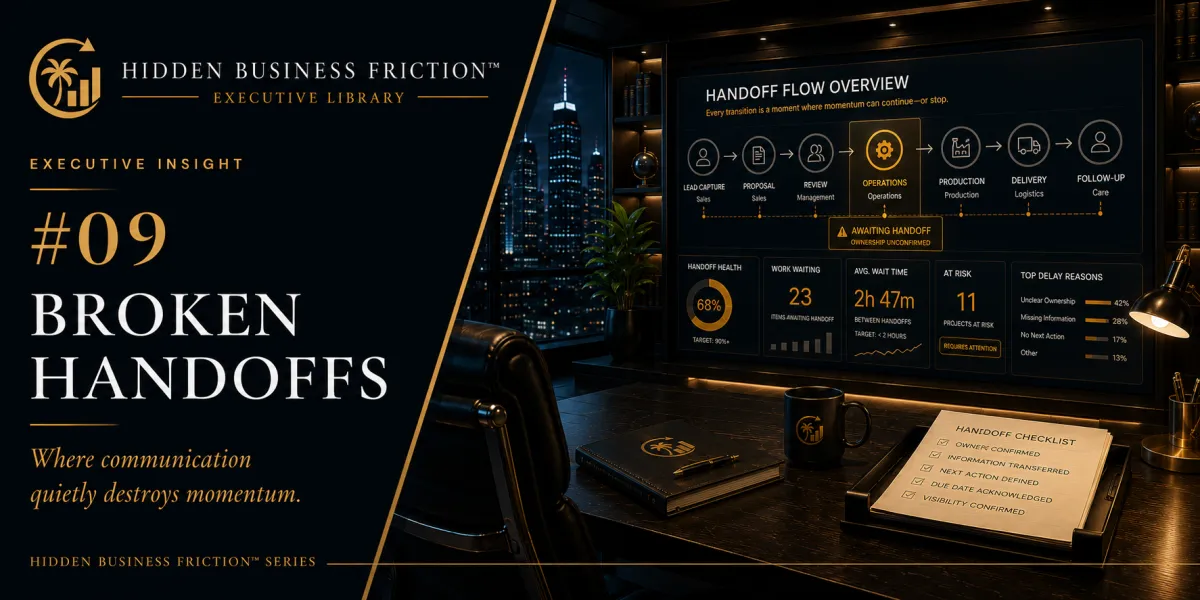
Hidden Business Friction™ #9
Broken Handoffs
5 min read • Executive Insight
Introduction
Most organizations believe work breaks down because people fail to communicate.
In reality, communication is often just the symptom.
The real problem occurs when responsibility quietly changes hands without anyone knowing exactly who owns the next step.
This is one of the most common—and expensive—forms of Hidden Business Friction™.
The Hidden Friction
Every organization relies on handoffs.
Sales passes opportunities to Operations.
Operations hands projects to Scheduling.
Scheduling coordinates Production.
Production hands completed work to Shipping.
Customer Service escalates issues to Technical Support.
Each transition creates a simple but critical question:
Who owns this now?
When that answer isn't immediately clear, momentum begins to disappear.
Projects stall.
Customers wait.
Employees assume someone else has taken over.
No single person made a mistake.
The work simply stopped moving.
Why It Matters
Broken handoffs create more than delays.
They create uncertainty.
Managers spend time chasing updates.
Employees duplicate work.
Customers lose confidence.
Leadership receives conflicting information.
As organizations grow, these small interruptions compound into significant operational friction.
The business isn't slowing because people stopped working.
It's slowing because work stopped moving.
Executive Perspective
Many leaders respond to stalled projects by asking for better communication.
More meetings.
More emails.
More status updates.
But communication alone doesn't solve ownership.
Healthy organizations don't rely on people remembering to pass work along.
They build visibility into every transition so everyone knows:
Who owns the work.
What happens next.
When action is required.
Where progress has stopped.
That's not better communication.
It's better operational design.
Questions for Leadership
Can you identify who owns every active project at any given moment?
Are handoffs clearly documented between departments?
Can leadership immediately see where work has stalled?
Does responsibility transfer consistently, or rely on verbal communication?
How often do customers ask for updates because no one contacted them first?
Key Takeaways
Most operational friction occurs between teams, not within them.
Communication shares information; ownership drives execution.
Visibility during handoffs prevents delays before customers notice them.
Reliable transitions create consistent customer experiences.
Continue Exploring Hidden Business Friction™
Next Executive Insights
→ Hidden Business Friction™ #10 - The Hidden Cost of Constant Interruption
→ Hidden Business Friction™ #11 - Automation Doesn't Fix Chaos
→ Hidden Business Friction™ #12 - Visibility Before Automation
Discover Your Organization's Hidden Friction
Every organization experiences operational friction.
The difference is whether leaders can see it before it begins affecting customers, employees, and growth.
The Hidden Business Friction™ Executive Diagnostic helps identify the invisible bottlenecks, ownership gaps, process breakdowns, and operational blind spots that quietly reduce performance across your organization.
Gain a clearer understanding of where friction exists—and where the greatest opportunities for improvement begin.
Complete the Hidden Business Friction™ Executive Diagnostic to discover where hidden friction may be limiting your organization's potential.